West of Vancouver Island, British Columbia, Canada – M 6.6, 6.8, and 6.5 Oct 22, 2018 from 05:39:40 to 06:22:28 UTC

Position: 49.250°N 129.478°W, 11.0 km depth at 05:39:40 UTC, Magnitude 6.6
               49.347°N 129.214°W, 10.0 km depth at 06:16:28 UTC, Magnitude 6.8
               49.314°N 129.673°W, 10.0 km depth at 06:22:48 UTC, Magnitude 6.5


USGS Information Pages:
https://earthquake.usgs.gov/earthquakes/eventpage/us1000hfgn/executive
https://earthquake.usgs.gov/earthquakes/eventpage/us1000hfgv/executive
https://earthquake.usgs.gov/earthquakes/eventpage/us1000hfh3/executive

This is a sequence of earthquakes occurring in the Pacific ocean approximately  200 – 225 km southwest of Port Hardy B.C.

Tectonic Summary

From the USGS information page

Over the course of 43 minutes on October 22, 2018 a series of M6.6, M6.8 and M6.5 earthquakes occurred off of Vancouver Island, Canada. These earthquakes occurred as a result of strike-slip faulting at shallow depths on the boundary or within the interior of the Explorer microplate. Focal mechanism solutions for the earthquakes indicate rupture occurred on either a near-vertical right-lateral northwest-southeast striking fault, or along a near-vertical left-lateral northeast-southwest striking fault. The tectonics of the Pacific margin of North America between Vancouver Island and south-central Alaska are dominated by the northwest motion of the Pacific plate with respect to the North America plate at a velocity of approximately 50 mm/yr. Convergence between the northern extent of the Juan de Fuca plate (also known as the Explorer microplate) and North America plate dominate the regional tectonics. The Explorer Ridge along the western side of the Explorer plate and the Sovanco Fracture Zone to the south define the boundary between the Pacific and Explorer plates. To the east, the Explorer plate subducts beneath the North American Plate. Eastward of the Sovanco Fracture Zone the Nootka fault separates the Explorer plate from the Juan de Fuca plate. As a result of these forces the Explorer plate is internally deformed and faulted and can produce diffuse seismicity away from its boundaries. Although a larger earthquake cannot be ruled out, previous sequences of large, closely spaced events in this region have not resulted in larger events, including a M 6.6 and M 6.4 in 2008 that were separated by an hour.The Explorer microplate is heavily deformed by internal dextral faulting, experiencing frequent moderate-sized earthquakes. Within approximately 70 km of these earthquakes, 11 earthquakes of M 6 or greater have occurred since 1951. The largest previous recorded earthquake in this region was a M 6.8 event that occurred on December 17, 1980.
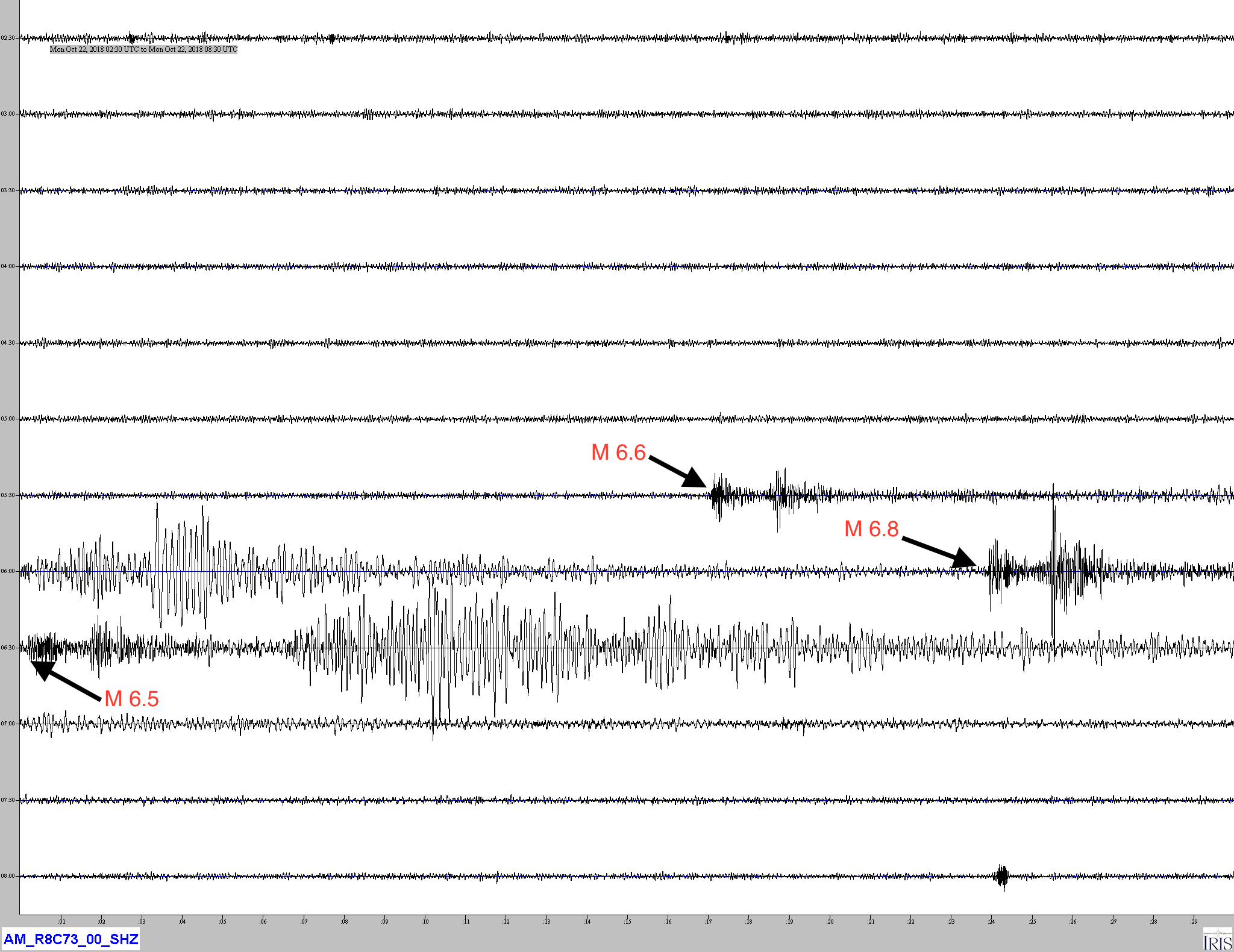
Jamaseis heliocoder trace of AM.RC8C73.00.SHZ. The P wave arrival times are annotated for the three quakes in the sequence. Notice that there are very large surface waves visible, even though this is a short period seismometer. This may be due to waves from the first earthquake reinforcing the amplitude of Love and Rayleigh wave from the subsequent events.

Distance: 4272 km
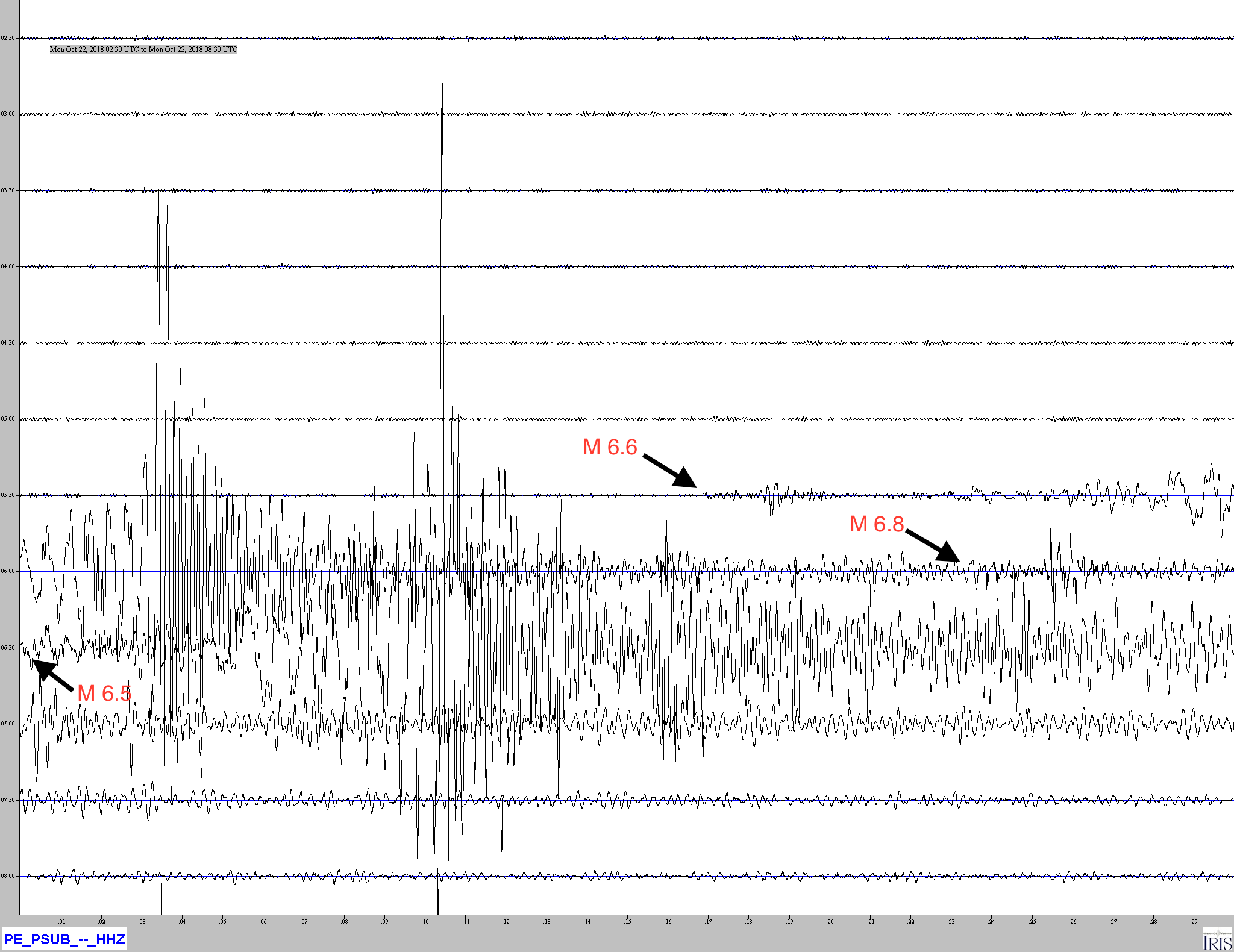
Similar trace from PE.PSUB.HHZ located at the Penn State University Brandywine Campus in Media PA. As this is a broadband instrument, the surface waves are much larger. Both this and the AM.R8C73 traces are filtered with a 1Hz low pass filter.


Swarm traces of the P wave arrivals for each of the three earthquakes in this sequence recorded by AM.R8C73.00.SHZ.
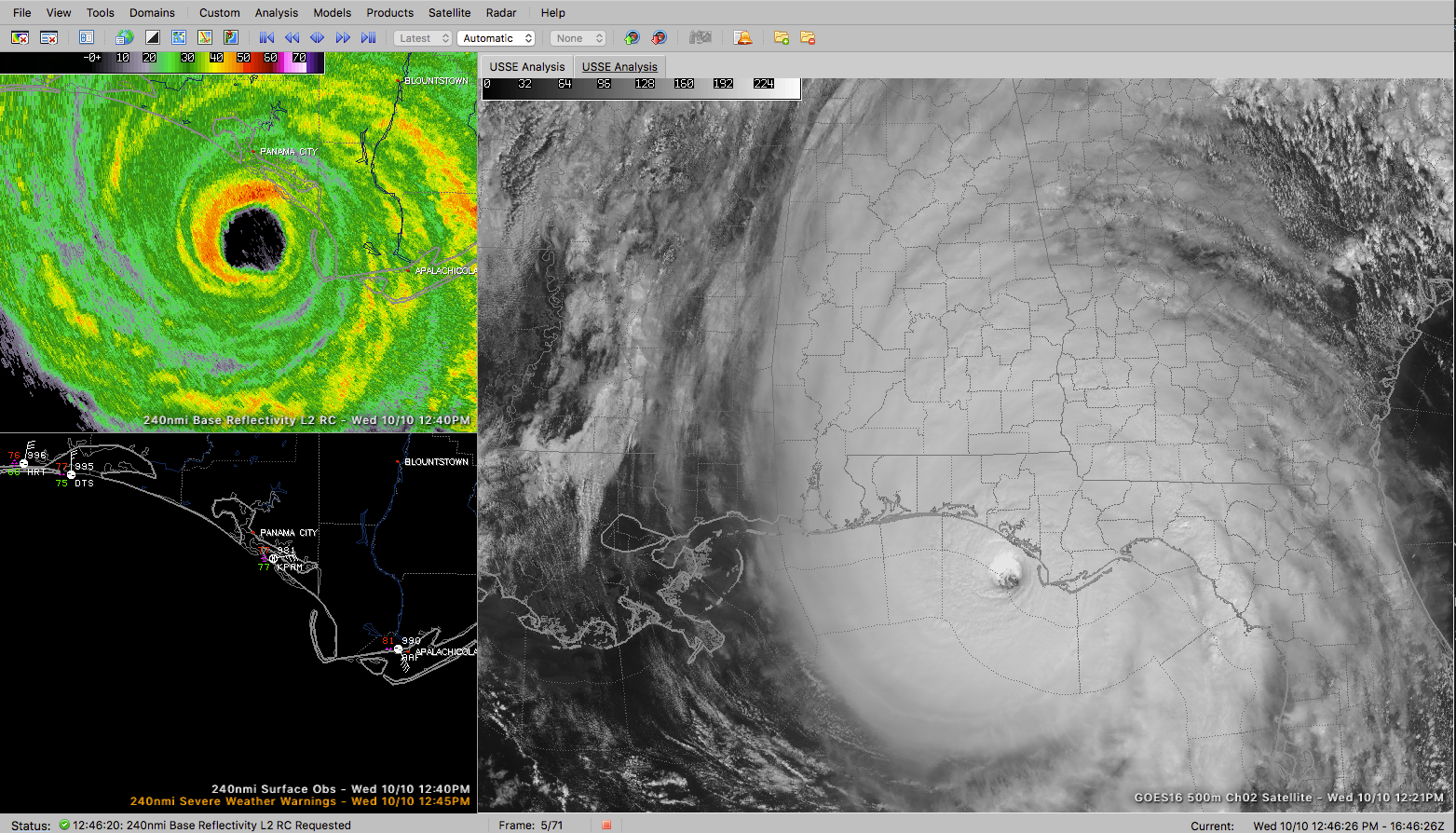
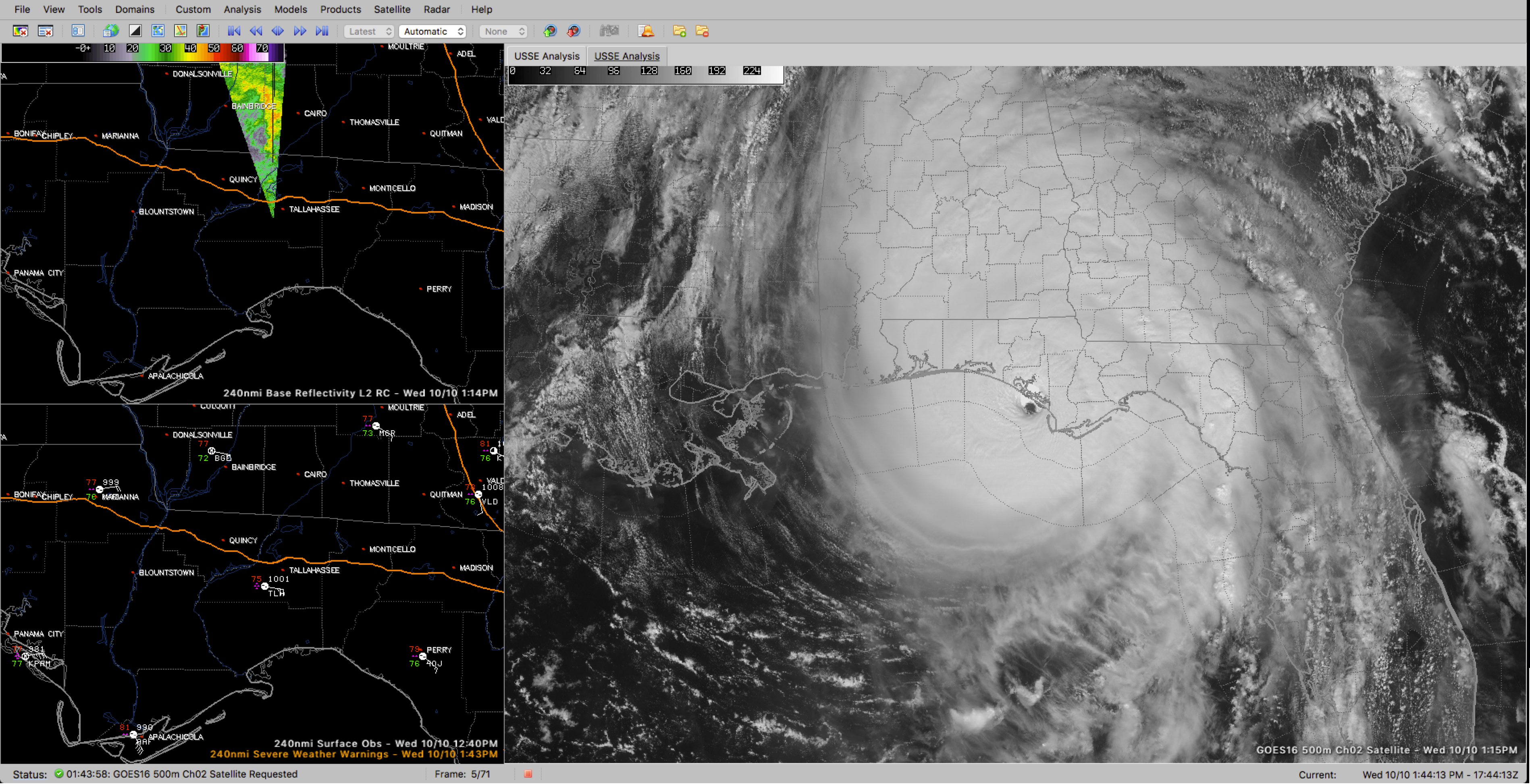
Hurricane Michael

Images

Here are two images of Hurricane Michael as it approached the Gulf Coast.

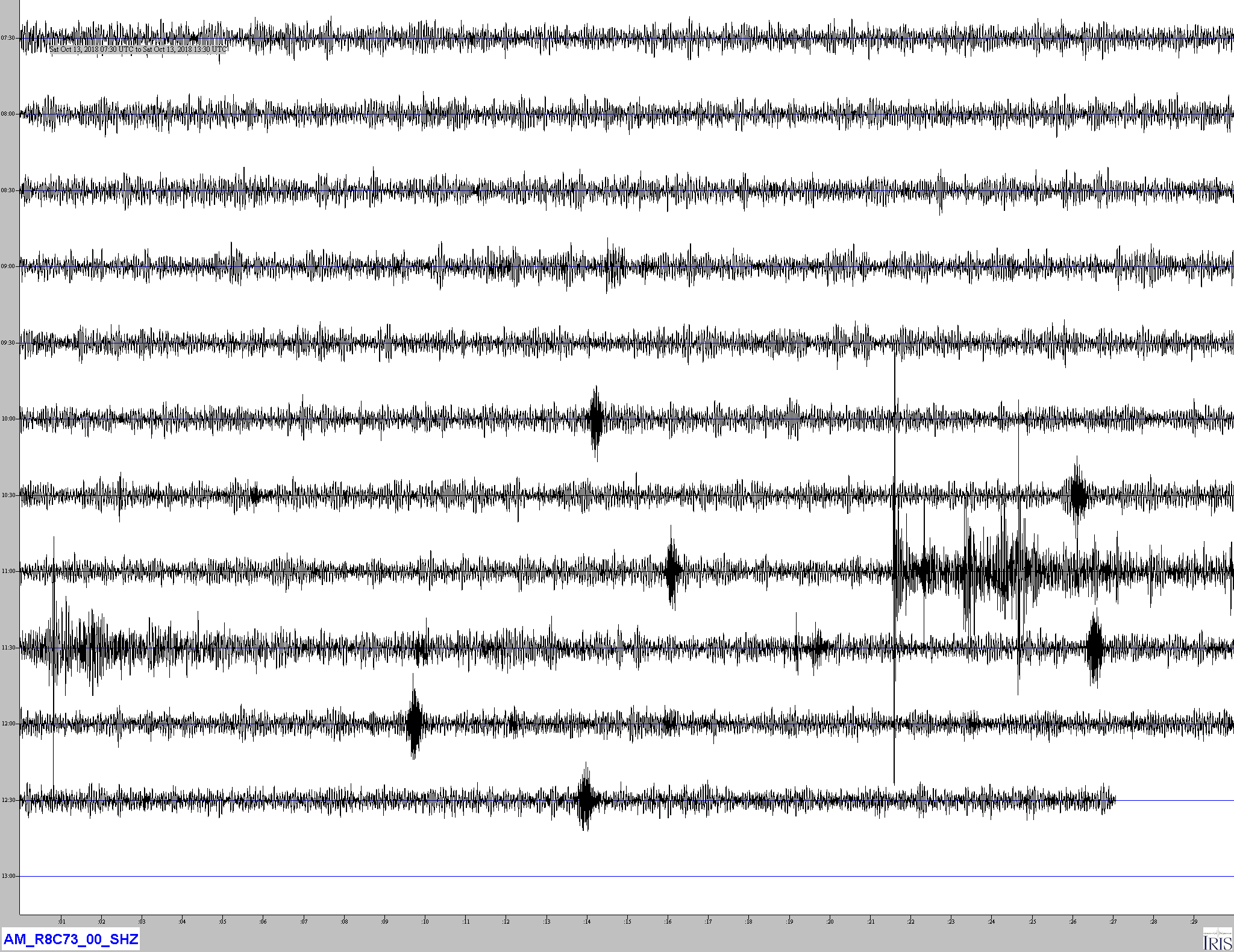
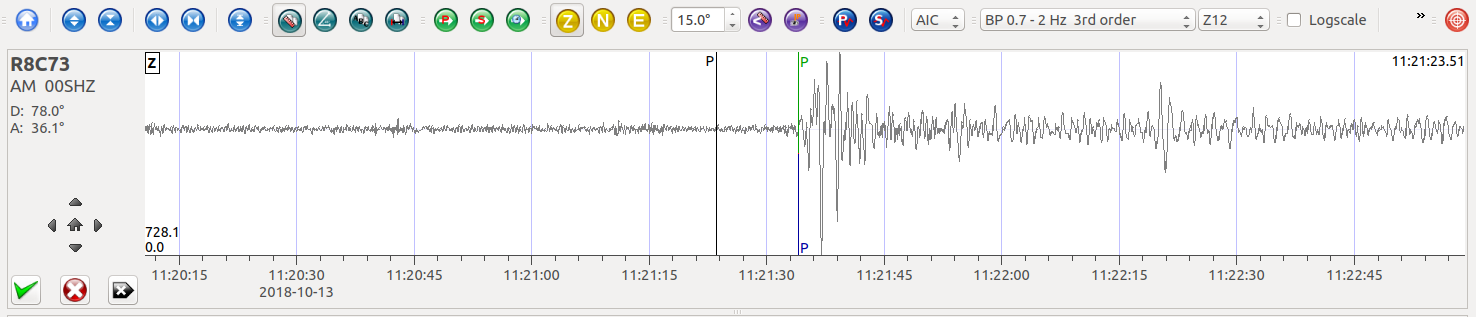
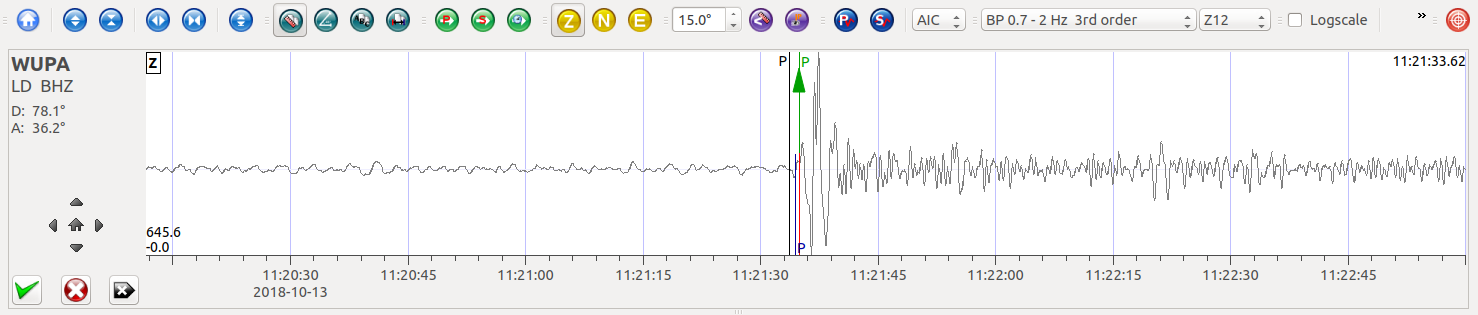
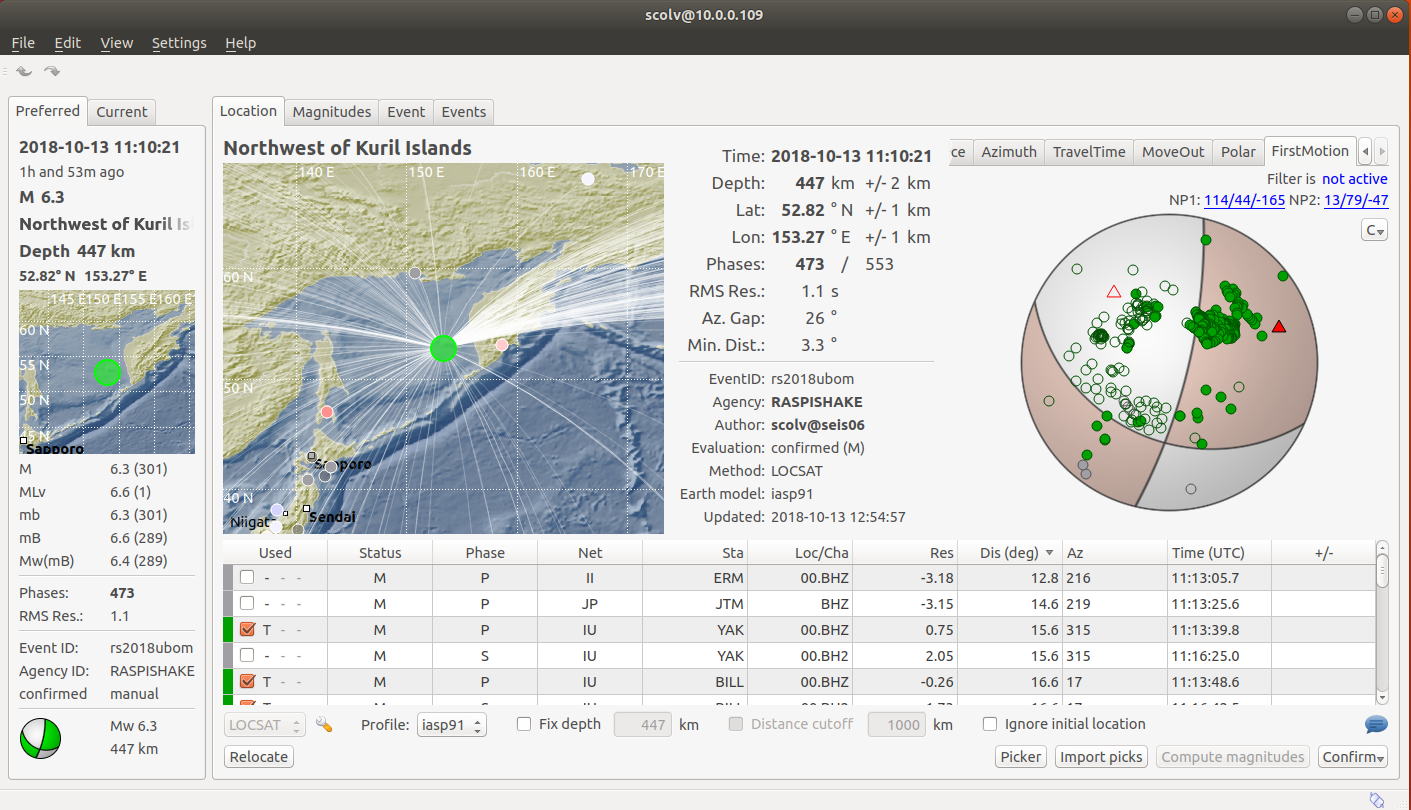
Sea of Okhotsk, Kuril Islands – M6.7 – Oct 13, 2018 at 11:10:23 UTC

Position: 52.861°N   153.379°E – Depth: 470.1 km

Jamaseis heliocoder trace of AM.RC8C73.00.SHZ of this earthquake.
Distance: 77.9 Deg. 8,668 km
Azimuth: 36.1 Deg.

SeisComP3 traces for AM.R8C73.00.SHZ (Exton PA) and LD.WUPA.BHZ (West Chester University, West Chester PA) showing the P wave arrivals.

SeisComP3 display showing the focal mechanism for this earthquake.

Kuril Islands – M6.5 – Oct 10, 2018 at 23:16:02 UTC

Position: 49.348°N   156.213°E – Depth: 17.5 km

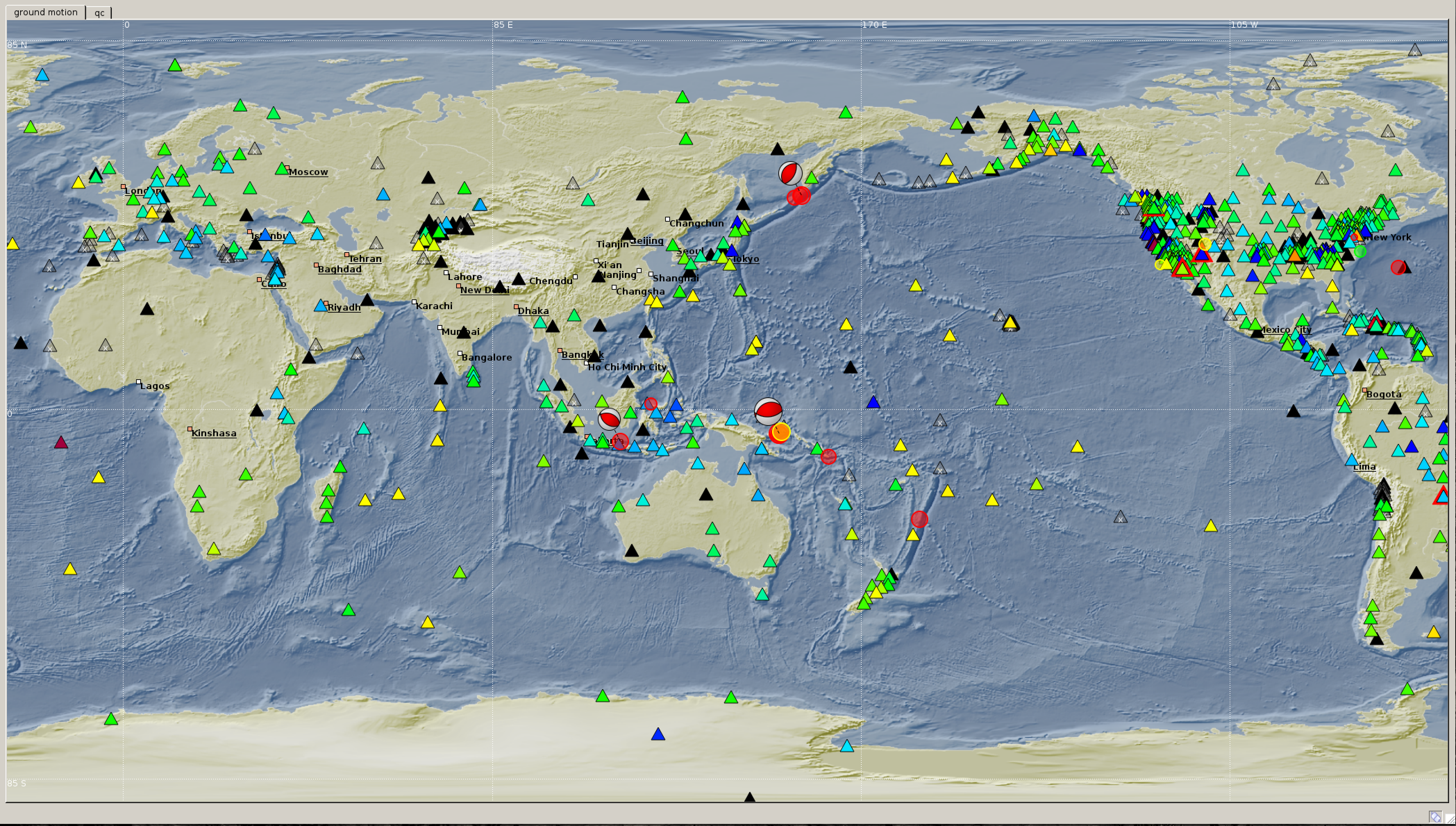
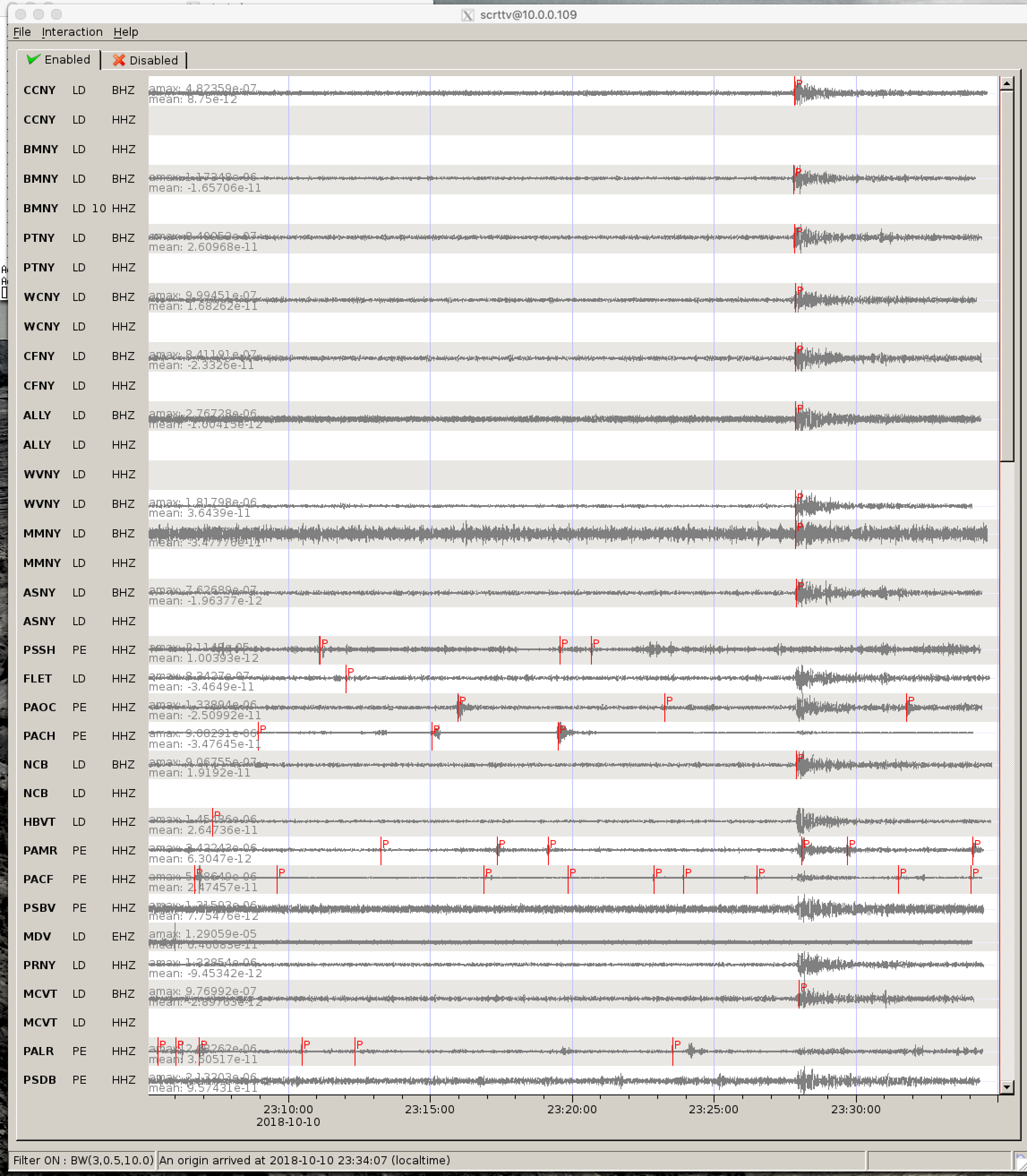
SeisComP3 scmv (Map View) showing the day’s earthquakes. The three with “beachball” diagrams are the events detailed here.

SeisComP3 traces for AM.R8C73.00.SHZ (Exton PA) and LD.WUPA.BHZ (West Chester University, West Chester PA) showing the P wave arrivals.

Distance: 79.7 Deg, 8862 km

Azimuth: 37.6 Deg.

New Britain, Papua New Guinea – M7.0 Oct 10, 2018 at 20:48:20 UTC

Position: 5.678°S   151.198°E – Depth: 40.3 km

Tectonic Summary

From the USGS Information Page:

The October 10, 2018, M 7.0 earthquake east of Kimbe, Papua New Guinea, occurred as the result of thrust faulting on or near the plate boundary interface between the subducting Australia and overriding Pacific plates. At the location of the earthquake, the Australia plate moves towards the east-northeast at a velocity of 105 mm/yr with respect to the Pacific plate, and begins its subduction into the mantle beneath New Britain at the New Britain Trench, south-southeast of the earthquake. The moment tensor and depth of the event are consistent with thrust-type motion on the interface between these two plates. Note that at the location of the earthquake, some researchers consider the edges of the Australia and Pacific plates to be divided into several microplates that take up the overall convergence between the Australia and Pacific plates, including the Solomon Sea and South Bismark microplates local to this event. The Solomon Sea microplate moves slightly faster and more northeasterly with respect to the Pacific plate than does the Australia plate due to sea-floor spreading in the Woodlark Basin several hundred kilometers to the southeast of the October 10th earthquake, facilitating the classic subduction evident beneath New Britain.

While commonly plotted as points on maps, earthquakes of this size are more appropriately described as slip over a larger fault area. Thrust-faulting events of the size of the October 10, 2018, earthquake are typically about 40×20 km (length x width).

The plate boundary between the Australia and Pacific plates in the Papua New Guinea region is very active seismically; 28 M 7+ events have occurred within 250 km of the October 10, 2018 earthquake over the preceding century. Few are known to have caused shaking-related fatalities because of the remoteness of the region, though a M 8.0 earthquake in November 2000—one of three similarly sized events over a 2-day period—did cause several deaths. A M 7.2 earthquake in May 1985, just 20 km to the northwest of the October 10, 2018 earthquake, also resulted in one fatality, though that event was a strike-slip earthquake in the upper plate, much shallower than today’s shock. The largest nearby earthquake was a M 8.1 event, 250 km to the northeast of the October 10, 2018, earthquake.

The October 10th earthquake was preceded by several minutes by a M 5.9 earthquake, just to the southeast of the M 7.0 event. In the two hours since the M 7.0 earthquake, several aftershocks have also occurred, including two moderate-sized (M 5.7 and M 5.9) events just to the southwest, and a larger M 6.2 shock 100 km to the northeast and at a depth of about 120 km, within the subducting Australia slab rather than on the interface between the two plates.

One of 4 Magnitude 6+ Earthquakes within a few hours

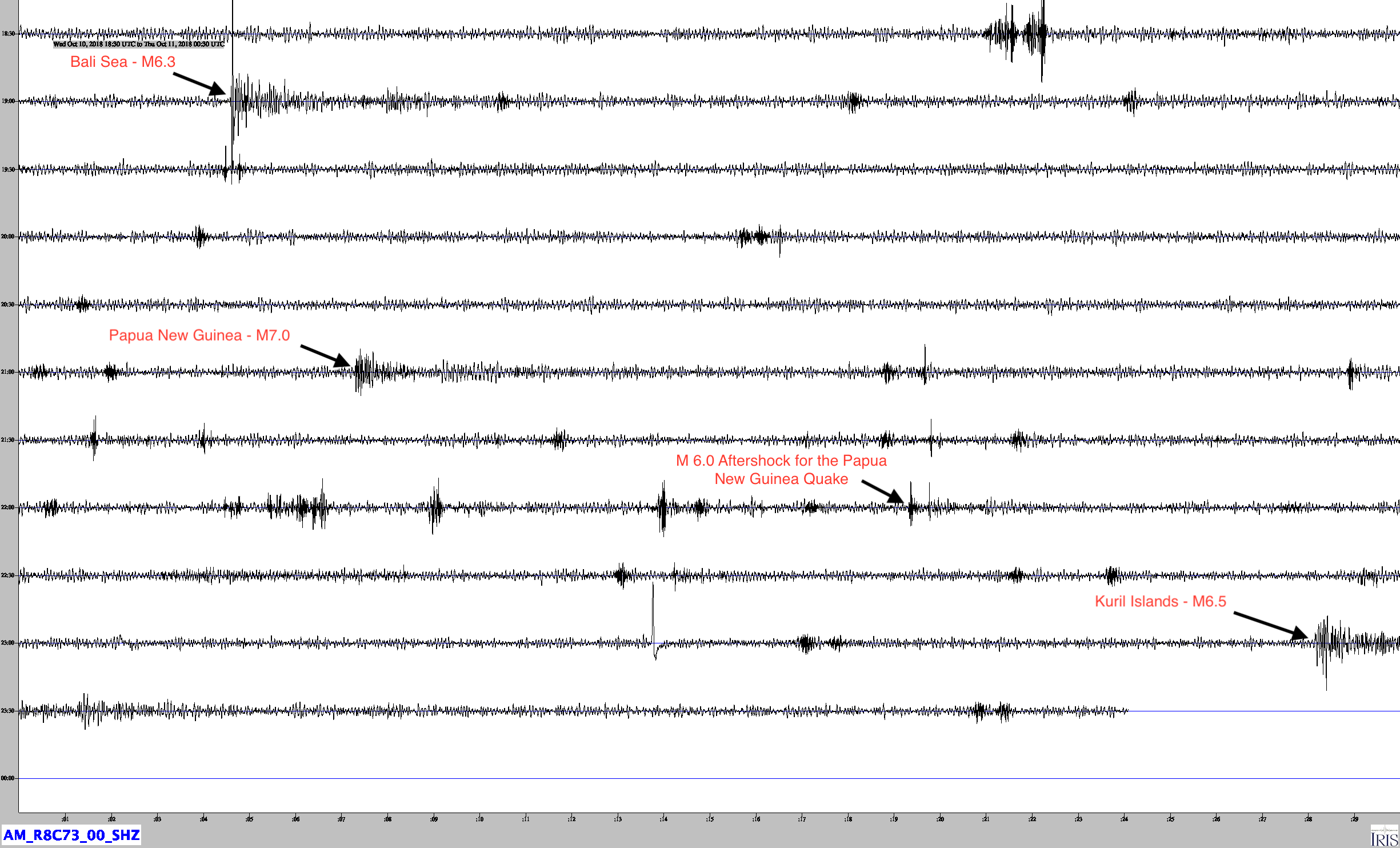
Jamaseis heliocoder trace of AM.RC8C73.00.SHZ. Four earthquakes are recorded on this graph.
Distance: 126.0 Deg. 13,988 km
Azimuth: 43.3 Deg.
SeisComP3 traces for AM.R8C73.00.SHZ (Exton PA) and LD.WUPA.BHZ (West Chester University, West Chester PA) showing the P wave arrivals.
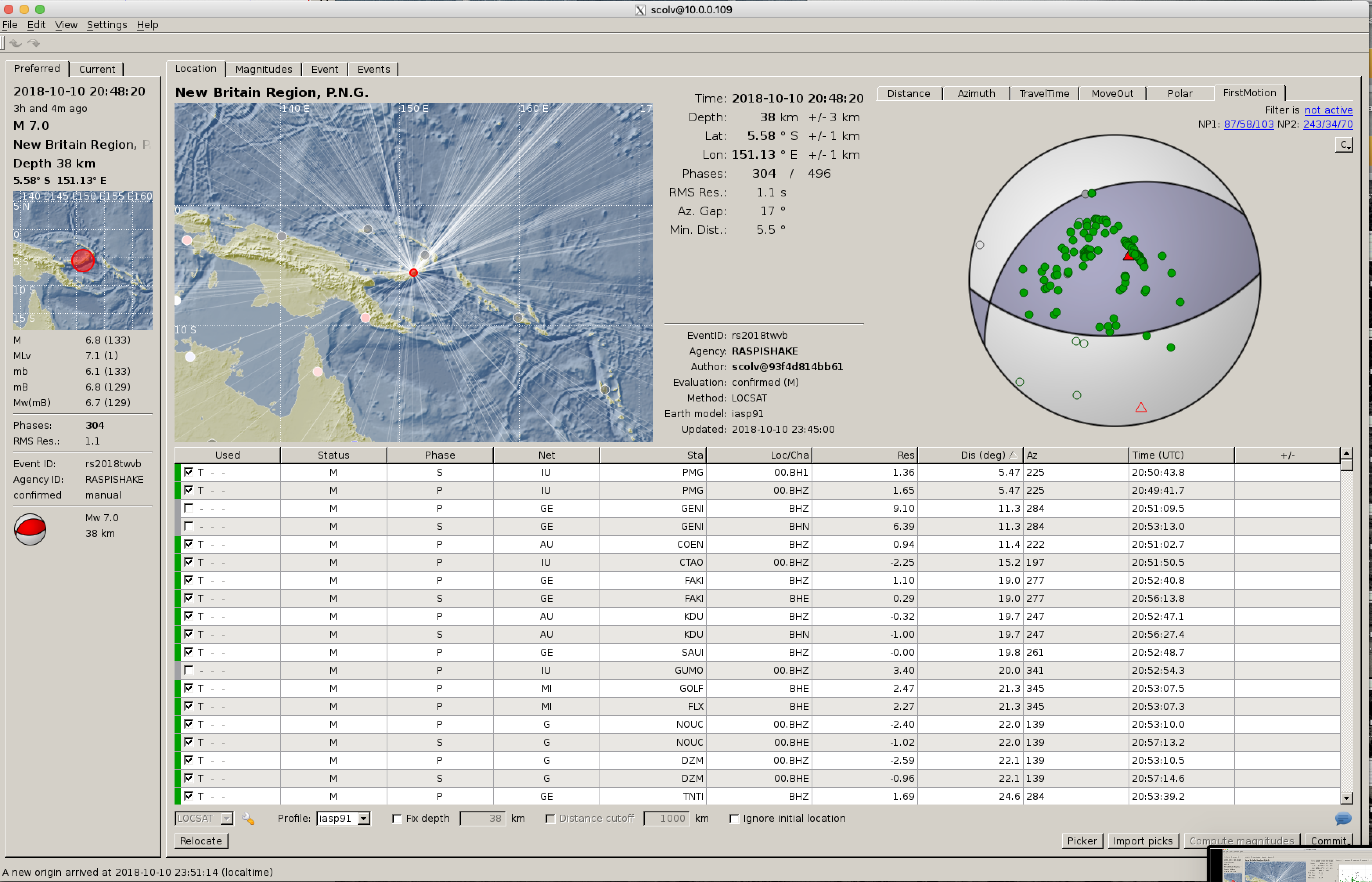
SeisComP3 display showing the focal mechanism for this event.
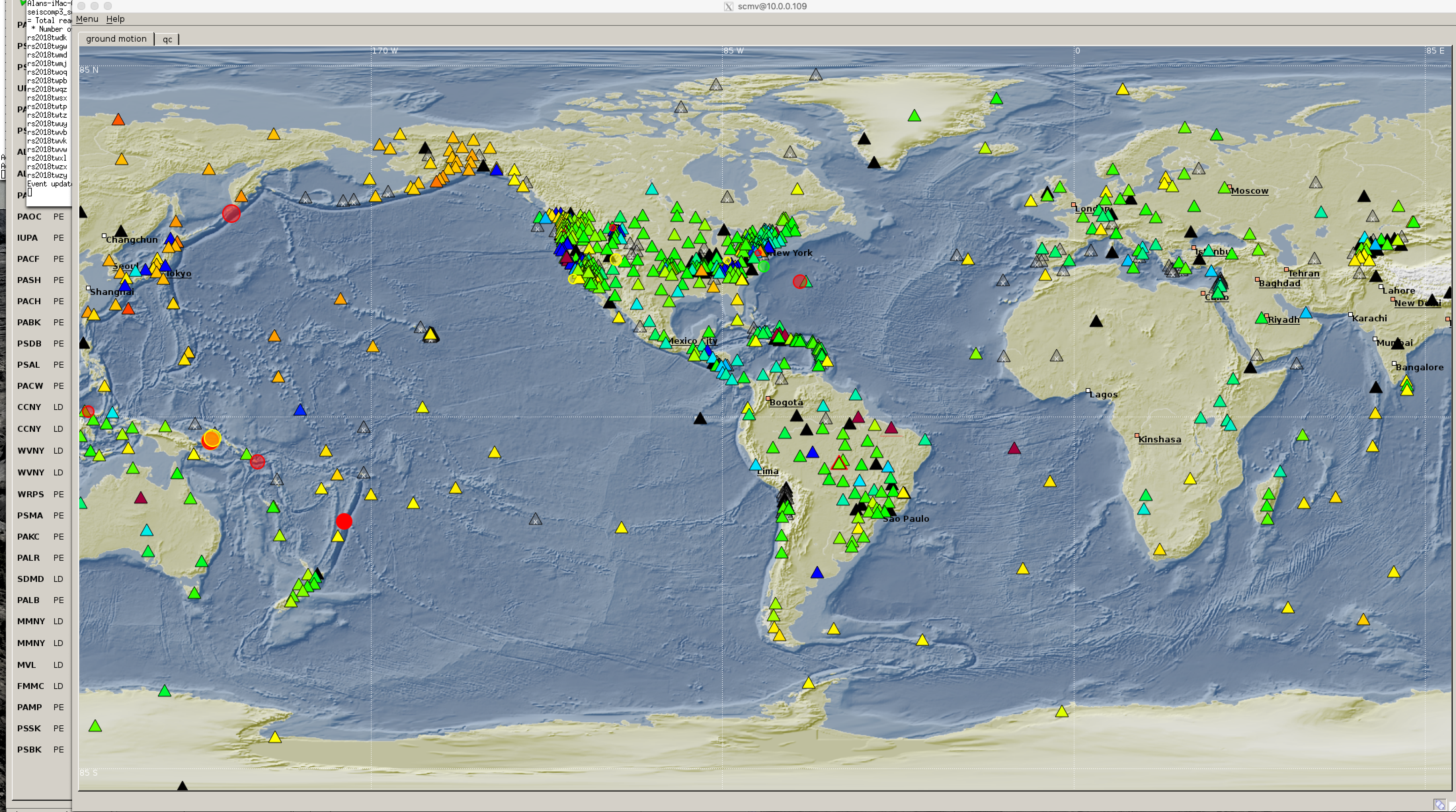
SeisComp3 Map View display of the seismometers monitored by Extonweather. Many are colored yellow or orange indicating strong ground motion after the quake.
SeisComp3 scrttv multi-station display showing the earthquake traces across the northeastern United States.