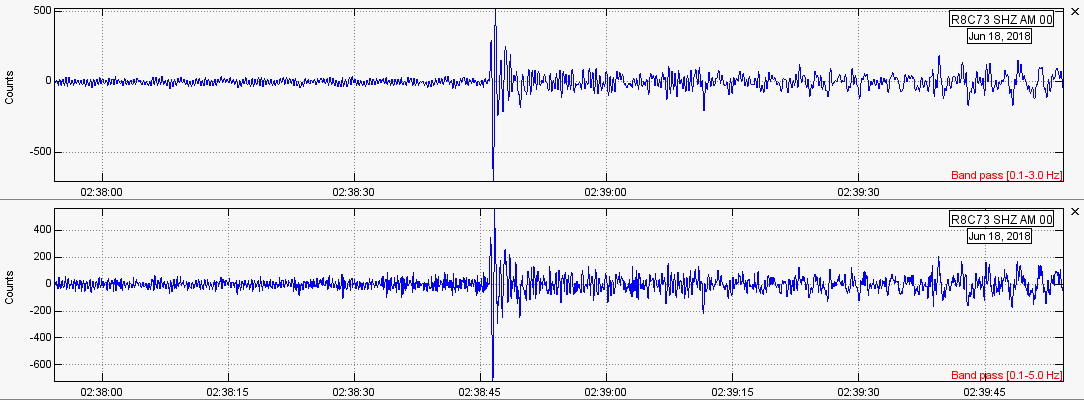
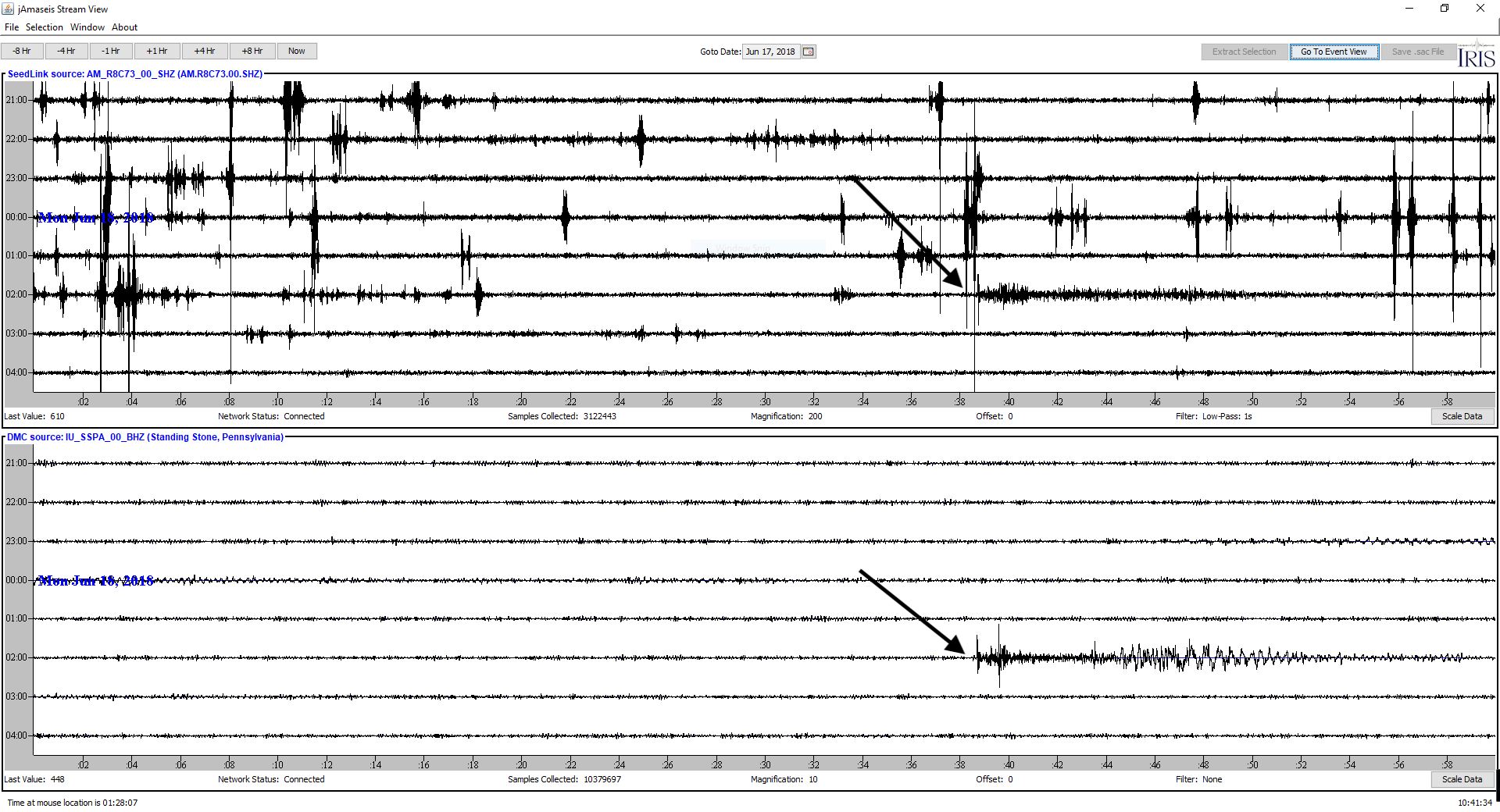
Guatemala M5.7 – June 18, 2018 at 02:32:55 UTC

Position: 114.130°N   90.712°W – Depth: 98.3 km

Jamaseis heliocoder trace of AM.RC8C73.00.SHZ and IU.SSPA.BHZ (Standing Stone PA).
Distance: 3,201 km
Azimuth: 23.5 Deg.

Image in Swarm of AM.R8C73.00.SHZ with two different filters.

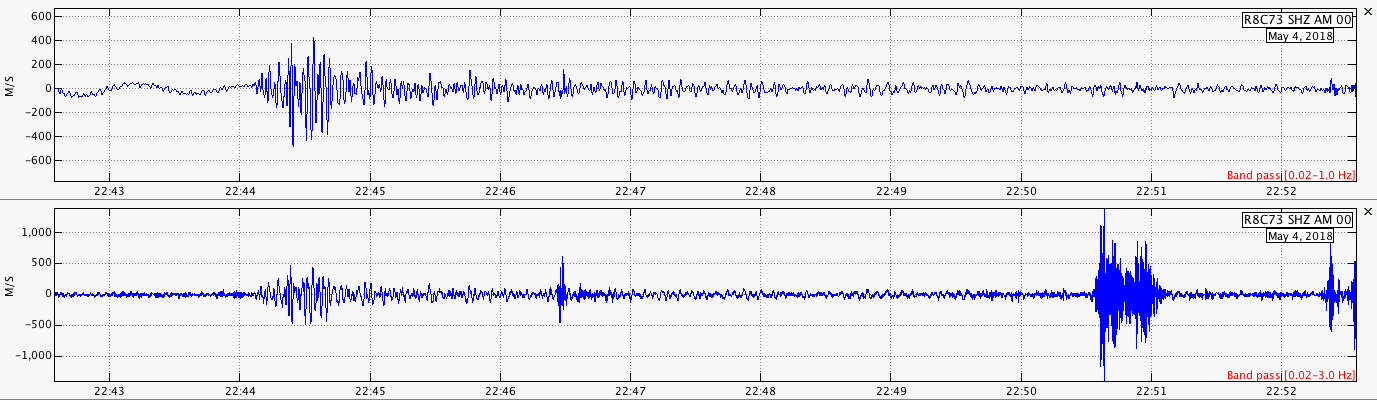
Hawaii M6.9 – May 4, 2018 at 22:32:54 UTC

Position:19.313°N   154.998°W – Depth: 2.1 km

From the USGS Summary of this event:

“The May 4, 2018, Mw 6.9 earthquake in Hawai’i occurred as a result of reverse faulting on the south flank of Kilauea volcano, in the east rift zone. Preliminary focal mechanism solutions indicate rupture occurred on shallow dipping thrust fault striking southwest, or on a steeply dipping reverse fault striking northeast. This earthquake is directly associated with volcanic activity at Kilauea volcano, and the evolution of its rift system and volcanic edifice.

Seismic activity has been elevated around Kilauea volcano over the past month, punctuated over the past ~24 hours with at least 7 earthquakes of M 4.5 or larger. On May 3rd, 2018, a M 5.0 occurred nearby the M 6.9 earthquake. About an hour prior to the M 6.9 event, a M 5.4 earthquake also struck in a similar location with a similar focal mechanism solution. Since the M 6.9 earthquake, 4 aftershocks of M 4.5 or larger have been located (all in the 30 minutes following the mainshock).

Regionally, this is the largest earthquake in Hawai’i since the Ms 7.1 (USGS) / Mw 7.4 (ISC-GEM) / Mw 7.7 (Nettles and Ekstrom, 2004) Kalapana earthquake in 1975, which also generated a local tsunami that took 2 lives. Damage due to the 1975 earthquake and tsunami was estimated to total $4.1 million in Hawai’i. The 1975 earthquake occurred on a basal detachment fault, rather than in the shallower rift zone where recent activity has been occurring. Over the past century, 9 earthquakes of M 6 or larger have occurred around the Big Island of Hawai’i.”

Traces from AM.RC8C73.00.SHZ, Exton PA.
Distance: 7769 km
Azimuth: 53.3 Deg.

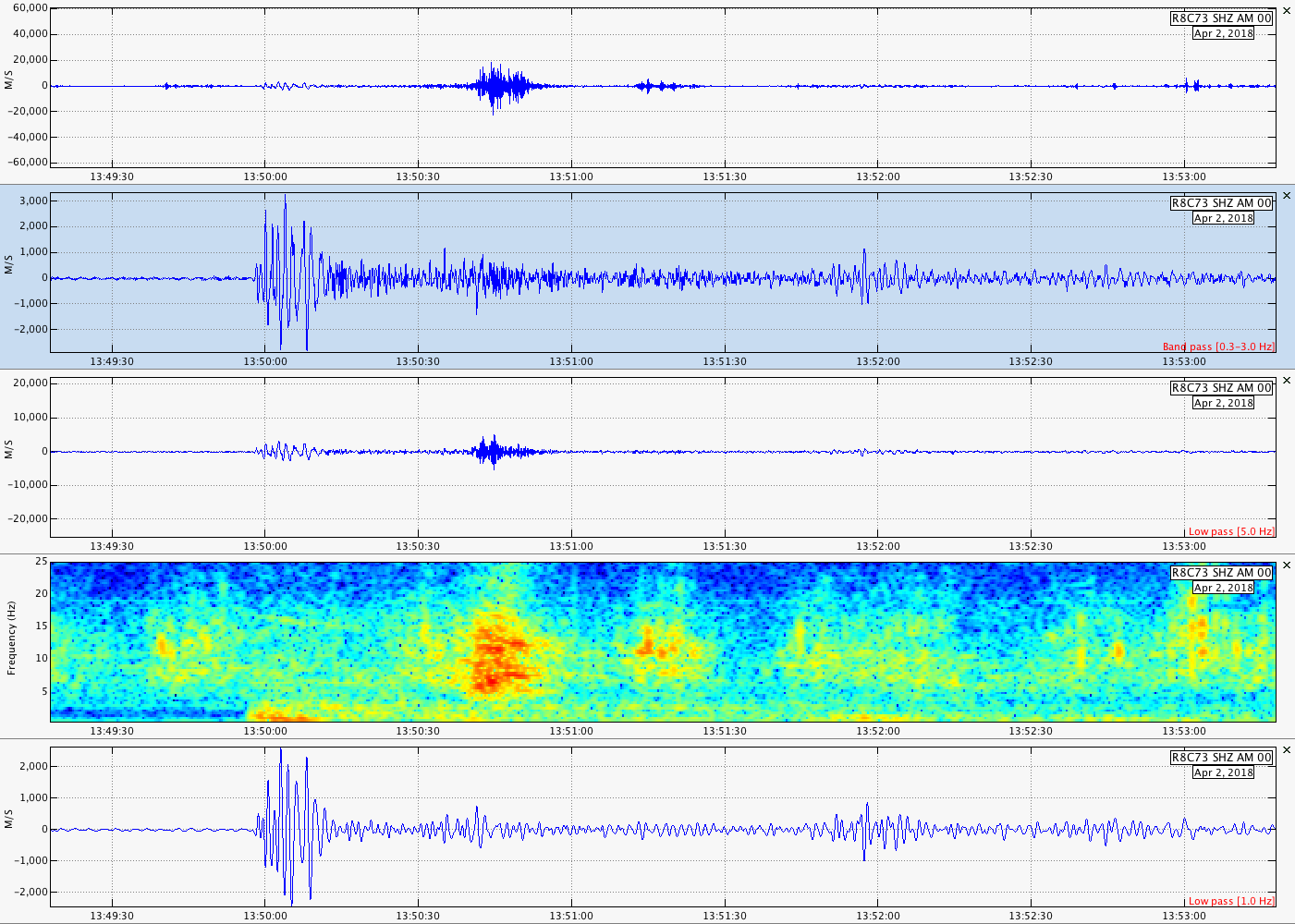
Papua New Guinea M 7.5 – Feb 25, 2018 at 17:44:43 UTC

6.070°S   142.754°E – Depth 25.2 km

From the USGS Summary of this event:

“The February 25, 2018, M 7.5 earthquake occurred as the result of thrust faulting at shallow a depth. Preliminary focal mechanism solutions indicate slip occurred on either a moderately dipping fault striking west-northwest, or on a moderately dipping fault striking southeast. At the location of this earthquake, the Australia plate is converging with the Pacific plate, moving towards the east-northeast with respect to Pacific lithosphere at a velocity of approximately 107 mm/yr. Earthquakes in this geographical region are generally associated with the large-scale convergence of these two major plates, and with the complex interactions of several associated microplates, most notably the South Bismarck plate, the Solomon Sea microplate, and the Woodlark plate. The location, depth, and focal mechanism solution of this earthquake are consistent with it occurring as intraplate faulting within the crust of the Australia plate.

While commonly plotted as points on maps, earthquakes of this size are more appropriately described as slip over a larger fault area. Thrust-faulting events of the size of the February 25th, 2018 earthquake are typically about 85×30 km (length x width).

Papua New Guinea experiences a high rate of seismic activity, with 23 other events of M 6+ occurring within 250 km of the February 25, 2018 earthquake over the preceding century. The closest of these was a M 6.2 earthquake in August 1993, about 17km to the north of today’s earthquake. The largest was a M 7.2 event in June 1986, 230 km to the north-northeast on or near the Australia:Pacific plate boundary in the region. With the exception of a M 7.5 earthquake at intermediate depth (186 km) in eastern Papua New Guinea in February 1963 (which occurred on the subduction zone at depth), all prior M 7.5+ earthquakes in this region have been associated with the shallow subduction zone plate boundaries in northern New Guinea. The vast majority of moderate-to-large earthquakes in this region are not known to have caused significant damage or casualties, though few have been as large as today’s earthquake. A M 7.1 earthquake in June 1976, 340 km to the northeast of this event, resulted in over 400 shaking related deaths. Landsliding also caused a significant number of additional fatalities in that event.”

Epicenter - 83km SW of Porgera, Papua New Guinea

6.07 deg South, 142.754 East, Depth 25.2 km

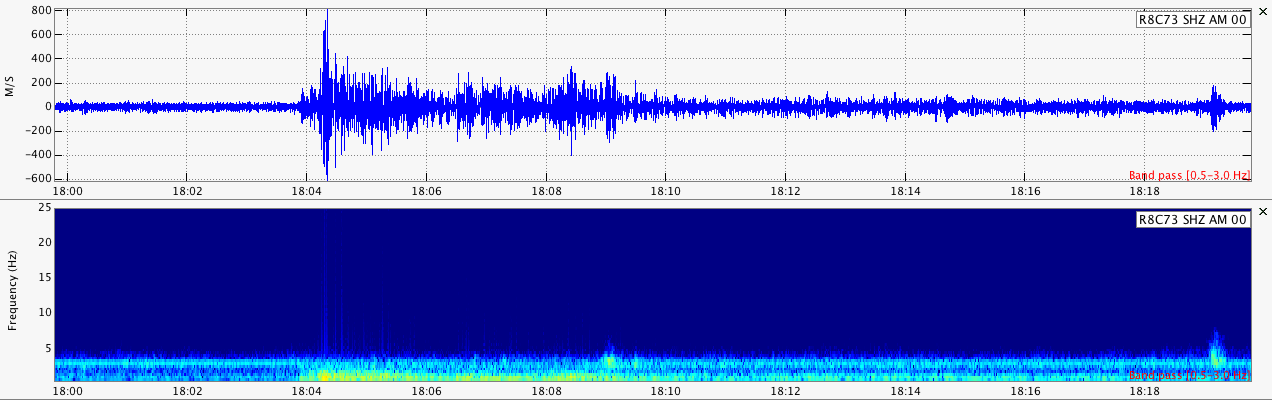
The quake as captured by AM.R8C73.00.SHZ in Exton PA (RaspberryShake 1D).
Distance: 14,651 km
Azimuth: 39.5 deg